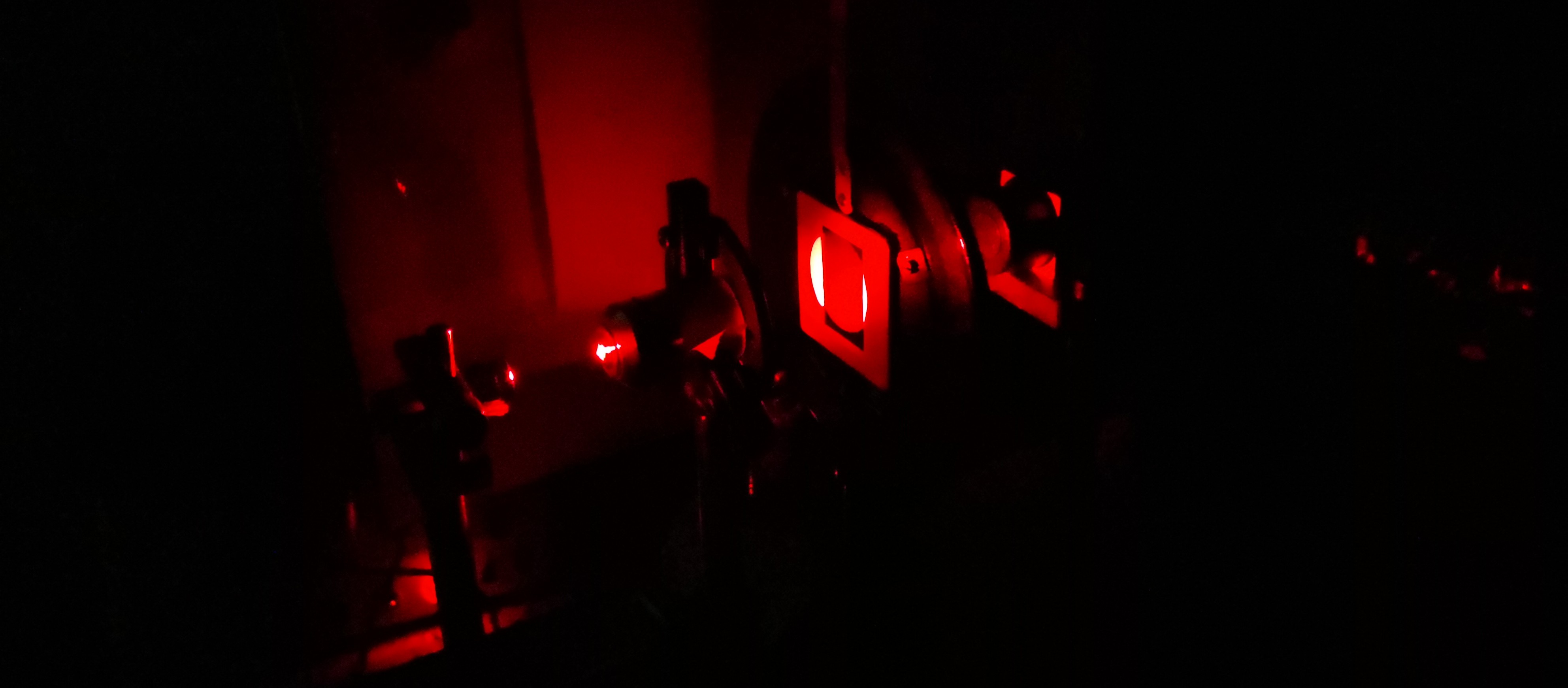
This microscope exploits the Talbot effect, first reported by Henry Fox Talbot (1836). The Talbot effect is a near-field diffraction phenomenon in which a periodic structure reproduces its own intensity pattern at discrete propagation distances, known as Talbot distances. This phenomenon represents an early observation of wave-optical self-imaging.
In this work, the Talbot effect is used to generate a self-image of an absorption grating, which is superimposed with a second grating to produce a moiré pattern. Moiré patterns were historically known in the textile industry, particularly in French fabric manufacturing. In optics they arise from the superposition of two periodic structures with slightly different phases or periods. Here, the moiré pattern acts as a carrier of phase information of the wavefront. A schematic of the setup is presented in Figure 1.
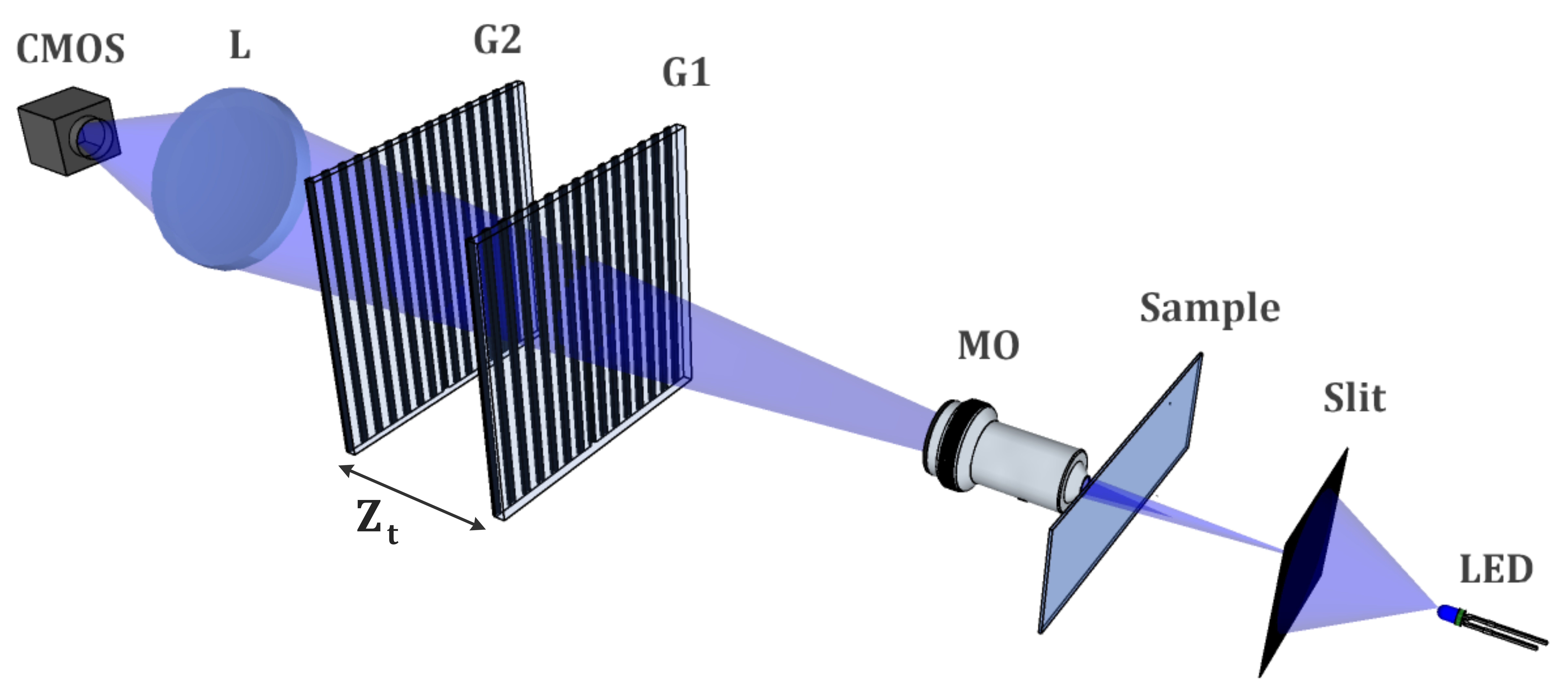
When a specimen is introduced into the beam, it locally distorts the wavefront, leading to measurable deformations of the moiré fringes. By analyzing these deformations using n-bucket phase-shifting algorithms, the local phase gradients induced by the specimen can be retrieved, yielding a differential phase-contrast (DPC) image.
The presented setup exhibits substantially improved noise robustness, primarily due to the use of a low-coherence illumination source, which strongly suppresses speckle and parasitic interference. In addition, phase-shifting reconstruction benefits from statistical averaging across multiple phase steps, further reducing noise sensitivity.
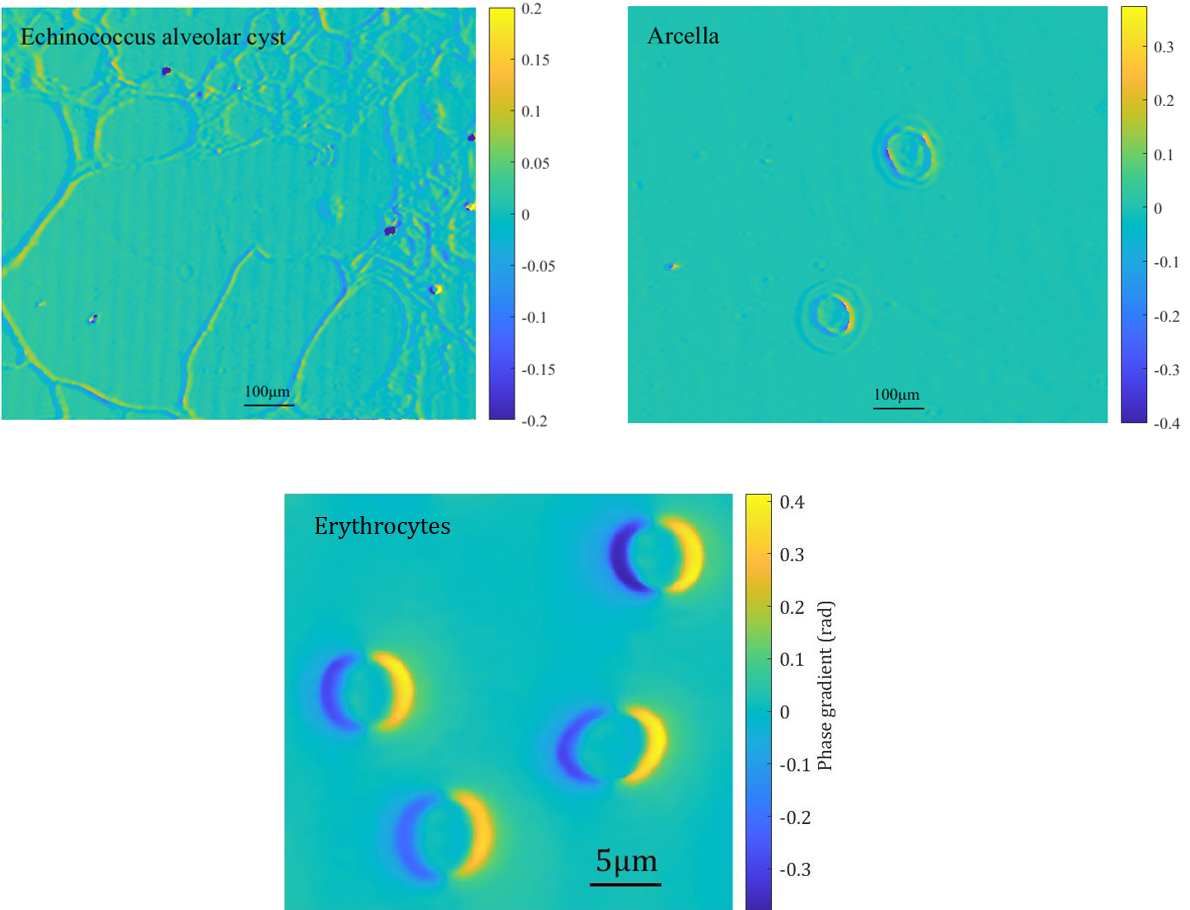
A key advantage of this Talbot-based interferometric configuration is that it can, in principle, provide three complementary contrast channels from the same measurement: absorption, DPC, and dark-field images. Although only DPC is demonstrated in the present publication [1], the simultaneous retrieval of all three modalities is well established in the X-ray Talbot–Lau regime and directly follows from the same physical principles [2]. A few examples of the acquired images are presented in Figure 2.
References
[1] Tajbakhsh, K., Ebrahimi, S., & Dashtdar, M. (2022). Low-coherence quantitative differential phase-contrast microscopy using Talbot interferometry. Applied Optics, 61(2), 398-402.
[2] Pfeiffer, F., Bech, M., Bunk, O., Kraft, P., Eikenberry, E. F., Brönnimann, C., … & David, C. (2008). Hard-X-ray dark-field imaging using a grating interferometer. Nature materials, 7(2), 134-137.